the myth: an overview
< 5 minutes
"A myth is a traditional story or folktale that has been handed down orally (through speech rather than through writing) for many generations. Additionally, myths are used to explain the world and people’s experiences within it, often using symbolism and allusion to discuss life, death, relationships, and spirituality. Such stories were especially relevant for ancient civilizations attempting to make sense of [that which] could not be explained by the scientific knowledge of the day." (Met Opera)
the underworld
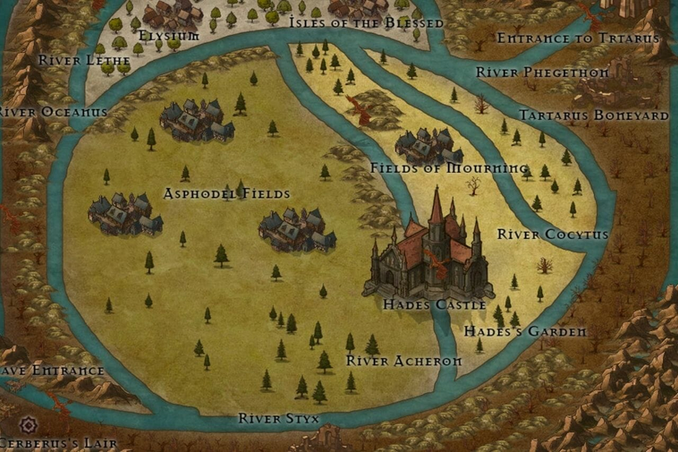
Image Source: Classical Literature
River Styx: The River which separates the world of the living from the Underworld.
River Acheron: The River which provides entrance to the Underworld, across which arriving souls must be transported by the ferryman Charon.
"They took me to a tiny boat. I only just fit inside. I looked at the oars and I wanted to cry." (Second Movement, Scene 1)
River Lethe: The River of Oblivion from which souls would drink to lose all memory of their past lives.
"They made me swim in a river and I forgot his name. I forgot all the names." (Second Movement, Scene 1)
River Lethe is the primary River that the characters in Eurydice refer to.

THE ELEVATOR
The rain from the elevator represents a second cleansing. While the River in the play (the River Lethe) removes all memories, the elevator's water removes memories of the River dunking.
THE UMBRELLA
Eurydice's umbrella that she exits the elevator with in the Second Movement, Scene 1 protects her from the rain inside the elevator. That is why she is able to recall being dunked.
The Underworld is ruled by Hades, who is the God of the Dead, and his wife Persephone.
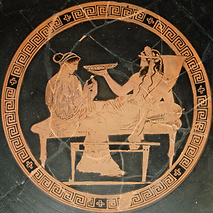
Kylix pottery by Vulci, 440-430 BCE
Not directly relevant to the play, but a good resource.
Lord of the Underworld as a character representation of Hades in Eurydice.
eurydice's death
While the story originated as an oral tradition in Ancient Greek mythology, it was famously adopted and retold by Roman poets whose narratives largely shaped subsequent adaptations.
The Georgics, Book IV
Virgil. ~29 BCE
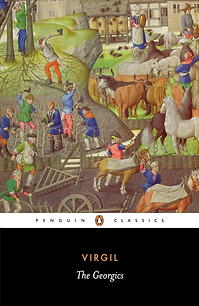
Aristaeus, a minor god of beekeeping, romantically pursues Eurydice after her marriage to Orpheus and chases her into the forest. Here, she is bitten by a poisonous snake that sends her to her death.
The Metamorphoses
Ovid. 8 AD
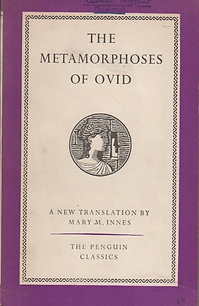
While dancing with dryads---female nature spirits like herself---on her wedding day to Orpheus, Eurydice is bitten by a poisonous snake that sends her to her death.
For information on Orpheus's death, see his character page.
the greek chorus
< 5 minutes
"We are a chorus of stones." (Movement Two, Scene 1)
Commonly in classical Greek dramas, a chorus informed the audience of where and what was taking place. The Stones in Eurydice operate as a chorus by facilitating movement from the world of the living to the Underworld, especially in the absence of a significant set indication. They provide commentary on the action of the other characters.
Thespis (6th century BCE) was the first dramatist to separate a single actor from the rest of the chorus in onstage interactions. Aeschylus (5th century BCE) reduced the chorus size and added a second primary actor, allowing for dialogue.
groups of threes
In the Greek Underworld, many key features came in threes, like the Stones in Eurydice. In addition to the three primary Rivers (Styx, Acheron, Lethe), these include the following:
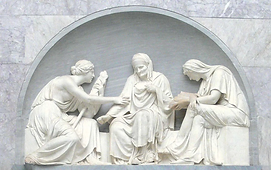
Sculpture of the Fates by Gottfried Schadow (1790)
The Fates
Clotho: the spinner of life's thread, representing birth
Lachesis: measures the length of the thread, or one's life
Atropos: the cutter of the thread, determining time and manner of death.
The Fates are often depicted as three ancient sisters and are not isolated to the Underworld, though they play a role in mortals' death.
The Regions of the Dead
Tartarus: eternal punishment for the wicked
Asphodel Meadows: resting place for the average souls
Elysium: a paradise for heroes and the virtuous
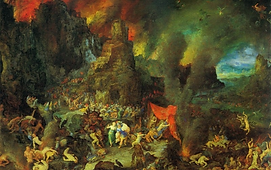
Image: Jan Brueghel the Elder
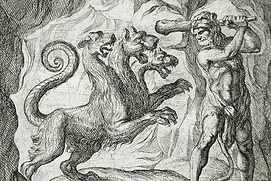
Cerberus's Three Heads
Cerberus is the multi-headed dog that guards the entrance to the Underworld, preventing the dead from escaping and the living from entering. In most iterations of the myth, there are three heads. Orpheus is said to have charmed Cerberus with his lyre and lulled it to sleep.
Image: Mythopedia
Also: the three Furies (goddesses of vengeance in Tartarus) and the three Judges (determiners of a soul's final destination in the Underworld).
popular adaptations
Most adaptations of the Orpheus x Eurydice myth listed below focus primarily on Orpheus's story. Sarah Ruhl's adaptation is unique in its focus on Eurydice's story instead.
-
"Eurydice," a poem by Hilda Doolittle (1917)
-
Orpheus Descending, a play by Tennessee Williams (1957)
-
The Song of Orpheus, a graphic novel by Neil Gaiman (1991)
-
Moulin Rouge!, a film by Baz Luhrmann (2001) and later, a musical (2018)
-
Metamorphoses, a play by Mary Zimmerman (2002)
-
Eurydice, a play by Sarah Ruhl (2003)
-
Hadestown, a folk opera by Anaïs Mitchell (2006) and later, a musical (2016)
-
Inception, a film by Christopher Nolan (2010)
-
"Talk," a song by Hozier (2019)
-
Portrait of a Lady on Fire, a film by Céline Sciamma (2019)
-
Never Look Back, a novel by Lilliam Rivera (2019)
-
Hades, a video game by Supergiant Games (2020)